Wildlife conservation and quality of life

LIGHTING MASTER PLAN

Light and Environment – Emissions Reduction Through Quality

The ecological impact of lighting is often reduced to energy consumption and CO₂ emissions. However, this perspective is too narrow. Light not only acts as an energy consumer but as an environmental factor: it alters nocturnal habitats, influences biological rhythms, and shapes the ecological balance of urban and peri-urban areas.
Wildlife protection
Wildlife protection

A lighting master plan therefore consciously expands the concept of the environment – moving away from purely quantitative efficiency considerations towards qualitative control of light emissions. The focus is not on maximum savings for individual parameters, but on the targeted reduction of undesirable lighting effects through precise planning.

1. Light emissions as a planning task

Artificial light produces emissions that extend beyond the actual space of use. These include, in particular:

  • Skyglow,
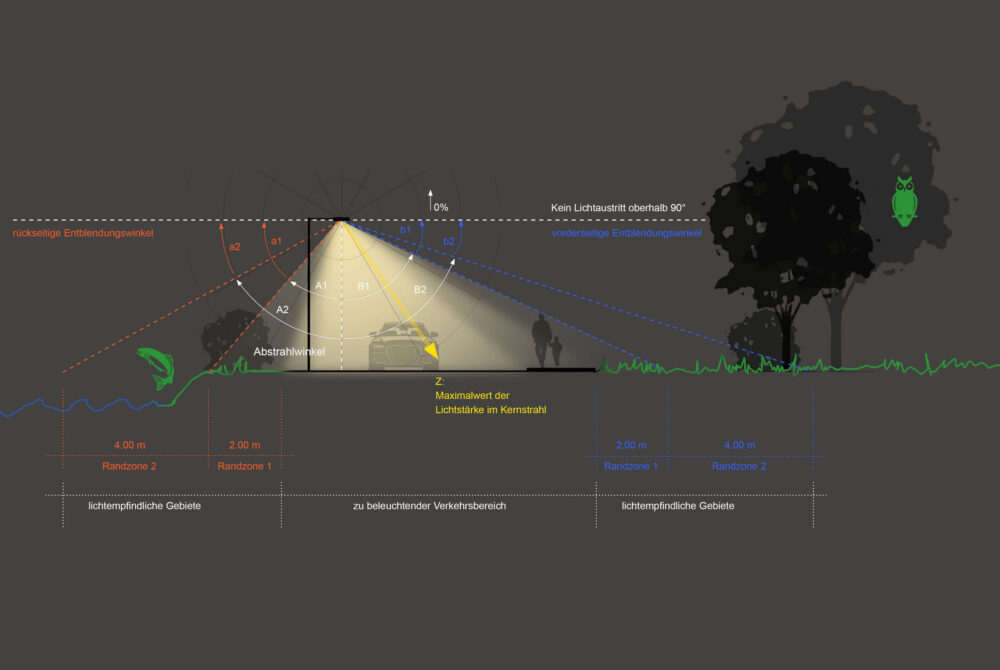
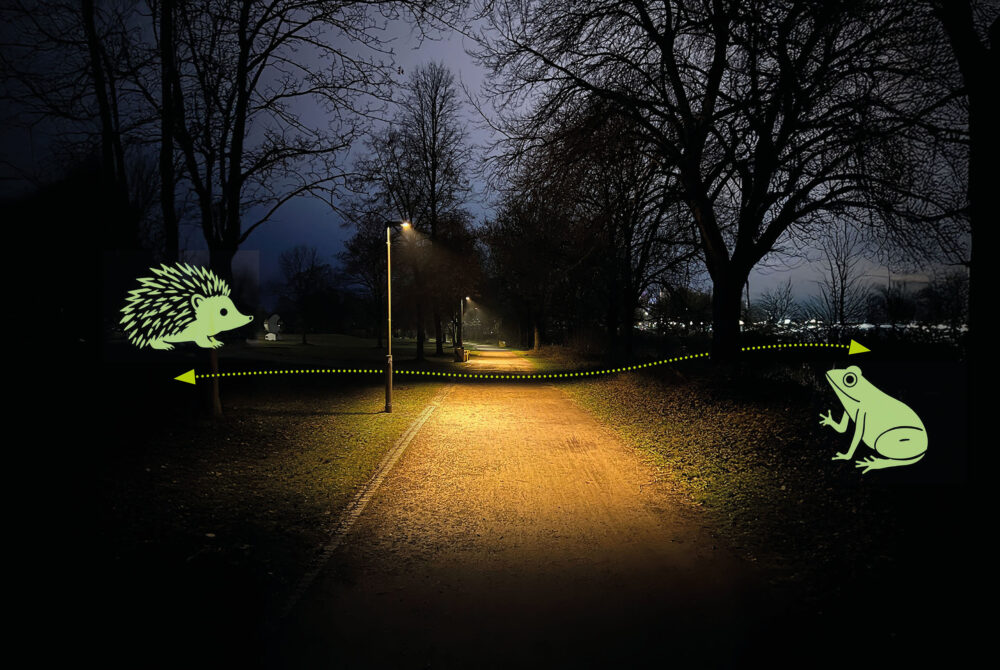
  • lateral spread into vegetation, water bodies or residential areas,
  • visual overlay of sensitive spaces by external light sources.

These effects are not necessarily caused by „too much“ light, but often by incorrectly placed, un­directed, or insufficiently shielded light. The lighting master plan therefore understands light emissions not as an unavoidable side effect, but as a plannable outcome.

2. Quality over quantity – Emissions reduction through precision

A central leitmotif of the lighting master plan is the realisation that ecological relief arises not primarily from a blanket reduction of lighting levels, but from their precise control.

Quality-oriented planning means:

  • Light is used exclusively where it is functionally required,
  • Light distributions are designed to precisely represent the usable space.,
  • Spurious radiation is consistently avoided.

High light quality allows for lower illumination levels without compromising visual comfort or safety. This not only reduces energy consumption but also the environmental impact.

3. Sensible spaces and transition zones

Cities do not consist of homogeneous spaces. Transitions between densely built-up districts, green spaces, bodies of water, or railway lines are particularly sensitive to light emissions. The light master plan places a clear focus here.

For such areas, the following applies:

  • Lighting must be spatially clearly defined and unambiguously directed,
  • Lighting positions and heights are consistently adapted to the usable space,
  • adjoining ecological structures are taken into account from the outset.

It is precisely at these interfaces that light quality determines whether infrastructure appears integrated or becomes a disruptive factor.

4. Light spectrum as part of the emission effect – without dogma

The spectral composition of light influences ecological processes, particularly in nocturnal insects and animals. The lighting master plan addresses this topic with deliberate nuance – without generalised simplifications or rigid requirements.

The decisive factor is its contextual application:

  • In ecologically sensitive areas, the spectrum is chosen with restraint,
  • in urban centres, visual comfort and the quality of stay are paramount,
  • Transition zones require graduated solutions rather than blanket provisions.

This ensures the light master plan remains practical and avoids over-regulation, without neglecting ecological aspects.

5. Operation as an environmental factor

Environmental impact arises not only from planning but equally from operation. Lighting systems have an effect every night – regardless of whether they are actually in use.
The lighting master plan therefore understands operational strategies as an integral component Ecological responsibility

  • temporally graduated lighting levels,
  • Adaptation to actual usage,
  • Conscious reduction in periods of low usage.

These measures reduce emissions without fragmenting the nocturnal cityscape or creating new uncertainties.

6. Environmental responsibility as part of urban quality

Ecological consideration is not understood as a restriction in the Lightmasterplan, but rather as a mark of quality.

A reduced, precisely controlled light pattern:

  • enhances the legibility of the urban space,
  • reduces visual clutter,
  • increases acceptance of lighting among the public and authorities.

Environmental compatibility thus arises not from renunciation, but from conscious design.

Light as a designed intervention in the night

The Ingolstadt Lighting Masterplan makes it clear: environmentally compatible lighting is not an additive aspect, but the result of good planning. Light emissions cannot be solved by technical means alone – they must be considered in terms of space, design, and operation. By using light precisely, its environmental impact is reduced – and at the same time, its urban spatial quality is enhanced. Light thus transforms from a factor of pollution into a designed component of a responsible urban nightscape.
S