Non-visual light effects

Lighting Design

Architectural lighting between biology, spatial effects and standards

Non-visual light effects are not a trending topic in the lighting industry. They are an expression of a biological reality: humans are evolutionarily shaped by daylight.
Over hundreds of thousands of years, the human circadian system evolved in natural environments – in the open air or in caves, surrounded by vegetation and bodies of water. Crucial was not only brightness, but the dynamics of light: the position of the sun, seasons, cloud cover, atmospheric scattering, and spectral changes.
In relation to this development, permanent stays in rectangular interior spaces with artificial lighting are a very recent phenomenon. Electric light has only existed for about 150 years; spectrally modulated LED lighting for a few decades.
Biophilic Design addresses this connection: architecture attempts to more strongly integrate natural environmental factors – materiality, vegetation, daylight – back into interior spaces. The most significant of these environmental factors is light.
Non-visual light effects thus describe not an additional function of luminaires, but the physiological reaction of an organism to an environmental parameter.
Melanopic light effect DGUV
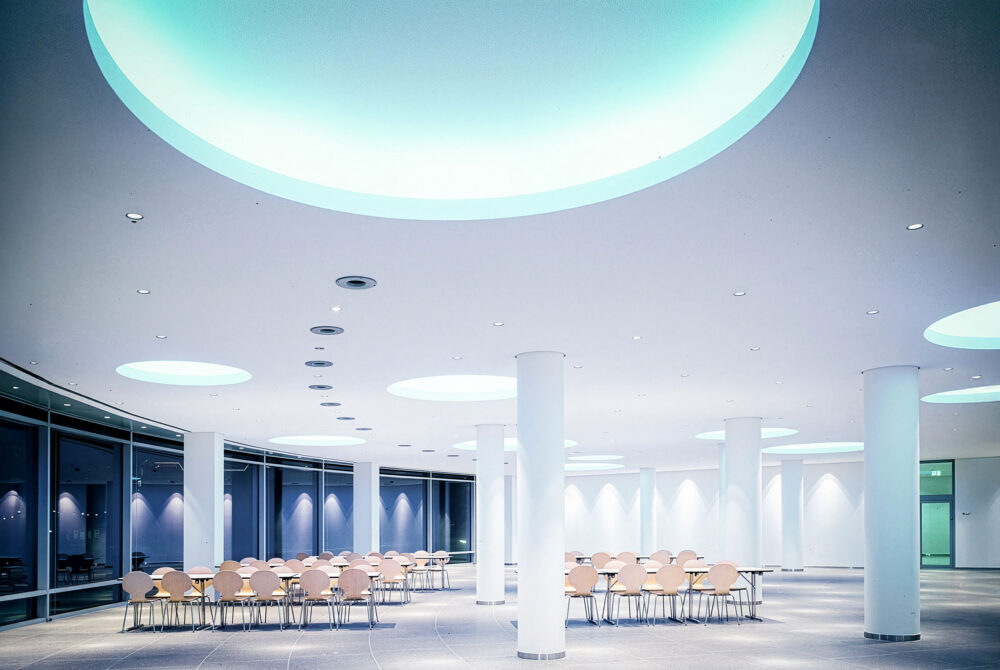
Munich Munich Gate
Bamboo forest
Evolutionary biological context

Light as an environmental factor

Non-visual light effects are not a trending topic in the lighting industry. They are an expression of a biological reality: Humans are evolutionarily imprinted by daylight.

Over hundreds of thousands of years, the human circadian system evolved in natural environments – in the open air or in caves, surrounded by vegetation and bodies of water. Crucial was not only brightness, but the dynamics of light: the position of the sun, seasons, cloud cover, atmospheric scattering, and spectral changes.

In relation to this development, permanent stays in rectangular interior spaces with artificial lighting are a very recent phenomenon. Electric light has only existed for about 150 years; spectrally modulated LED lighting for a few decades.
Biophilic Design addresses this connection: architecture attempts to more strongly integrate natural environmental factors – materiality, vegetation, daylight – back into interior spaces. The most significant of these environmental factors is light.

Non-visual light effects thus describe not an additional function of luminaires, but the physiological reaction of an organism to an environmental parameter.

Physiological Basis – Melanopic Lighting Effects

The non-visual effects of light are mediated by photosensitive retinal ganglion cells (ipRGCs). These cells contain the photopigment Melanopsin and are particularly sensitive to short-wavelength light around 480 nm.
The signals from these cells are sent directly to the suprachiasmatic nucleus in the hypothalamus – the central control centre of the circadian system. From there, they influence:

  • Sleep-wake cycle
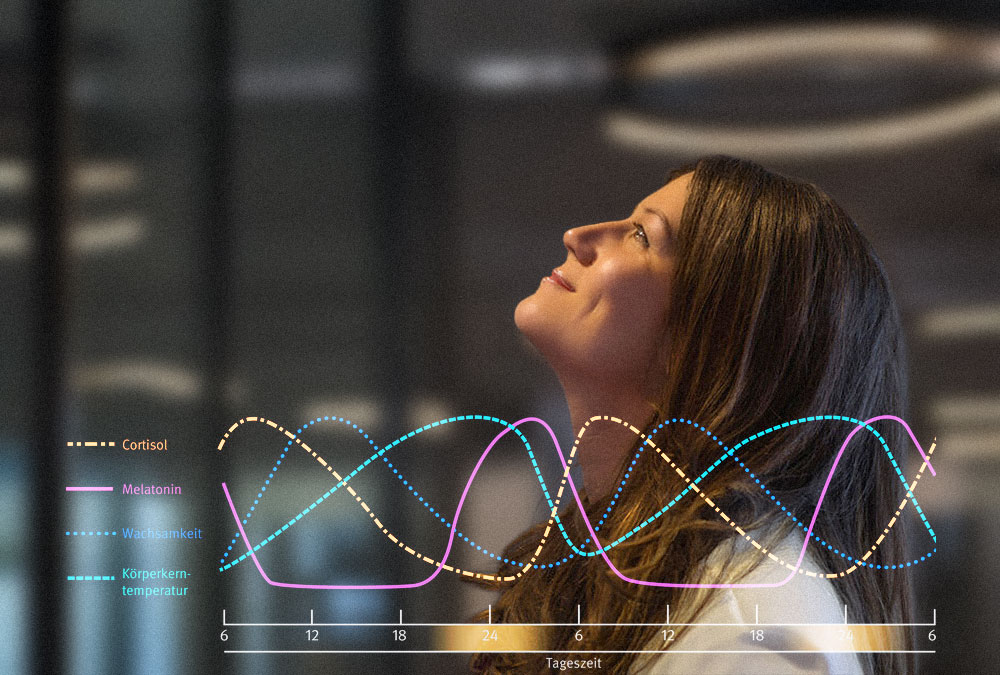
  • Hormone regulation (including melatonin and cortisol secretion)
  • Vigilance and attention
  • Vegetative processes

Unlike classical visual lighting, which is perceived in the eye via the cone and rod receptors, melanopic light acts independently of image formation.
Crucially, however: the biological effect does not depend solely on the blue component in the spectrum.
It arises from the interaction of:

  • spectral composition
  • vertical illuminance at the eye
  • Light distribution in the room
  • Exhibition duration
  • temporal progression
  • individual chronobiology (chronotypes)

This is where melanopic metrology comes in.

From Lux to MEDI – Quantifying Biological Effect

CIE S 026 marked the first introduction of an internationally harmonised metrological system for determining light responses influenced by ipRGC.
Building on this, DIN/TS 5031-100 defines α-optical parameters that serve as the basis for melanopic assessment. DIN/TS 67600 introduces the MEDI (Melanopic Equivalent Daylight Illuminance) parameter for design purposes. It describes the melanopic equivalent daylight illuminance at the eye.
A value of around 250 lx of melanopic EDI measured vertically at the eye is often cited as a consensus-based guideline for active phases. This value is based on scientific recommendations (including those by Brown et al.) and is reflected in certification schemes such as WELL – however, it is not a strict limit.
In addition, lighting data sheets increasingly include the melanopic efficacy factor (MDER or Melanopic Ratio), which describes the relationship between visual illuminance and biological efficacy.
These instruments are a significant advancement: they make non-visual light effects quantifiable and comparable.
However:
The melanopic assessment describes a physiological parameter. It does not replace the architectural decision regarding:
Spatial proportion
Materiality
Transparency
Length of stay
Usage context
Biological effect becomes measurable – spatial effect remains a design task.

Human Centric Lighting – industrial term, architectural differentiation

In planning practice, non-visual effects are frequently grouped under the term Human Centric Lighting (HCL). The term primarily originates from the luminaire and system industry and describes the attempt to translate circadian insights into technically controllable lighting solutions.
At its core, HCL pursues a legitimate aim: light should be oriented towards people. However, the simplification that often accompanies the term is problematic.
In many applications, HCL is reduced to:
Dynamically adjustable colour temperatures
pre-programmed daily routines
spectral adjustments within an LED system
These aspects are technically relevant – however, they only represent a fraction of what non-visual light effects actually encompass.
HCL describes a system behaviour, not automatically a room quality.
Non-visual light effects arise from the interaction of:
Spatial proportion and materiality
Luminance distribution in the field of view
Transparency and daylight factor
Duration and timing of exposure
Usage context
more punctiform than diffuse lighting
static as dynamic lighting
It is part of the entire spatial perception.
The equation „Biological effect = dynamic colour temperature“ is just as incomplete as the idea that a lunchtime meal consists of „noodles, sauce, and salt.“.
Non-visual light effects are not a feature. They are a design decision.

Direction, intensity and space – melanopic effect in context

A commonly simplified argument is: „Vertical lighting is biologically effective.“
That's correct – but incomplete.
The melanopic effect depends on how much light actually reaches the eye. Vertical lighting is therefore relevant because it directly affects the field of vision.

However:

  • Spot lighting can be selectively activated.
  • Diffused surfaces can be calming.
  • Horizontal lighting can be functionally crucial.
  • Static lighting can be used intentionally.

The question is not whether it's broad or specific. The question is, what effect is intended in the respective space.
Non-visual light effects are not a recipe, but a level of differentiation.

Temporal dramaturgy – beyond the simple daily curve

The biological effect of light is often depicted in a simplified way:

Morning = cold white and bright
Evening = warm and dim

Reality is more complex.

The circadian rhythm is individually determined, distinguishes chronotypes and responds to different activity and rest phases. It shifts depending on usage and duration of stay.

Architecturally, this means:

  • Light follows usage, not just the time.
  • The length of stay influences the dosage.
  • Dynamics must be adaptive.

Architecture sets the framework – light modulates it.

Threshold spaces, transparency and adaptation

Non-visual light effects begin at the transition.

Facades with highly reflective solar control glazing reduce visibility and transparency. Reflections diminish vertical luminance levels indoors. Adaptation processes are made more difficult.

Determining luminance ratios between exterior and interior:

  • Physiological adaptation
  • Orientation
  • Sense of security

Adaptation zones are therefore not decorative buffers, but physiologically relevant design elements.

Contrasts are not problematic in themselves.
 They can be used specifically to guide the eye and aid orientation. The key is to use them deliberately.

Non-visual effect on material – light protection as an opposite

Non-visual light effects do not only affect humans. Light also influences materials.

Increase shortwave radiation components:

  • Ageing processes
  • Changes in colour
  • Material degradation

In museums, exhibitions, or high-end retail spaces, a conflict of objectives arises between:

  • melanopic activation
  • conservational light protection

Non-visual lighting effects are therefore situated at the intersection of material protection, energy efficiency, and perception.

Normative framework – guidance, not a substitute for design

Non-visual lighting effects are scientifically substantiated and normatively described, but not mandatory.
Relevant fundamentals include, among others:

  • DIN EN 12464-1 (Annex B)
  • DIN/TS 5031-100
  • DIN/TS 67600
  • CIE S 026
  • DGUV Information 215-220
  • VDI 6011 Sheet 2

These frameworks provide assessment models. They structure planning. They enable comparability. However, they do not replace architectural lighting design.

Light quality over light quantity

A common misconception is that biological effect requires higher power.
Often, the opposite is the case.

Through

  • targeted vertical lighting
  • spectral optimisation
  • Daylight integration
  • Adaptive and time-controlled regulation

effective lighting environments can be created with reduced connected load.

Non-visual light effects are therefore not contradictory to energy efficiency. They can also be part of sustainable and eligible concepts.
This also leads to, for example, in companies, through employee well-being and health initiatives, reduced error rates and sick days, which enables a higher success rate and thus shorter working hours.

Design before delegation

DAY & LIGHT

In planning practice, non-visual lighting effects are often treated as a technical proof.
She regards DAY & LIGHT as a design parameter.
Non-visual impact arises where:

  • Proportion
  • Material
  • Daylight guidance
  • Transparency
  • Spatial Dramaturgy

to be defined at an early stage.

Specialist planners are integrated – however, based on an artistically developed lighting concept.
Not as a mathematical problem. But as an architectural translation between biology and space.