Bridges are far more than mere traffic structures. They connect urban spaces, overcome rivers, valleys, railway lines or traffic routes, and thereby shape the spatial structure of a city. Due to their exposed location and height, they are often visible over long distances and open up distinctive sightlines – particularly in cities on rivers, where bridges consciously integrate the landscape into the urban fabric.
This gives bridges a dual role: they are high-traffic transport links and, at the same time, urban landmarks with a strong visual impact over long distances. Light becomes a central instrument here to harmonise functionality, orientation, identity, and environmental responsibility.
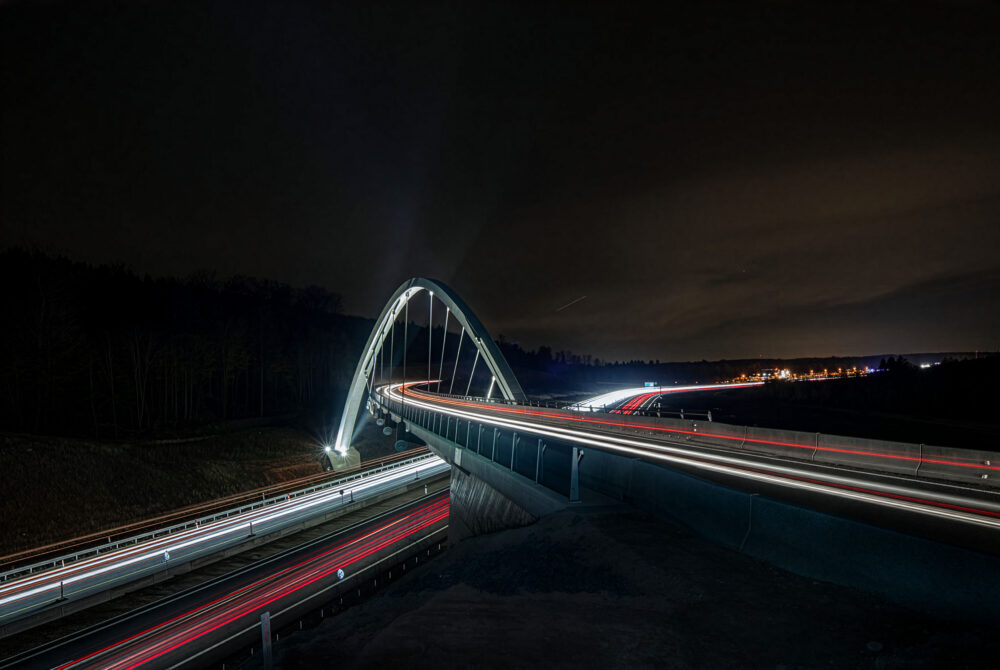
Classification and significance
High-quality bridge lighting always works on two levels: in the immediate area of use (roadways, pedestrian and cycle paths, crossings) and in the long-range effect on the urban landscape. The aim is to make the architecture legible without over-staging it – and to enable its safe use without the technology becoming the dominant feature.
What is crucial here is not the number of light sources, but their positioning, light distribution, glare control, and integration into the architecture.
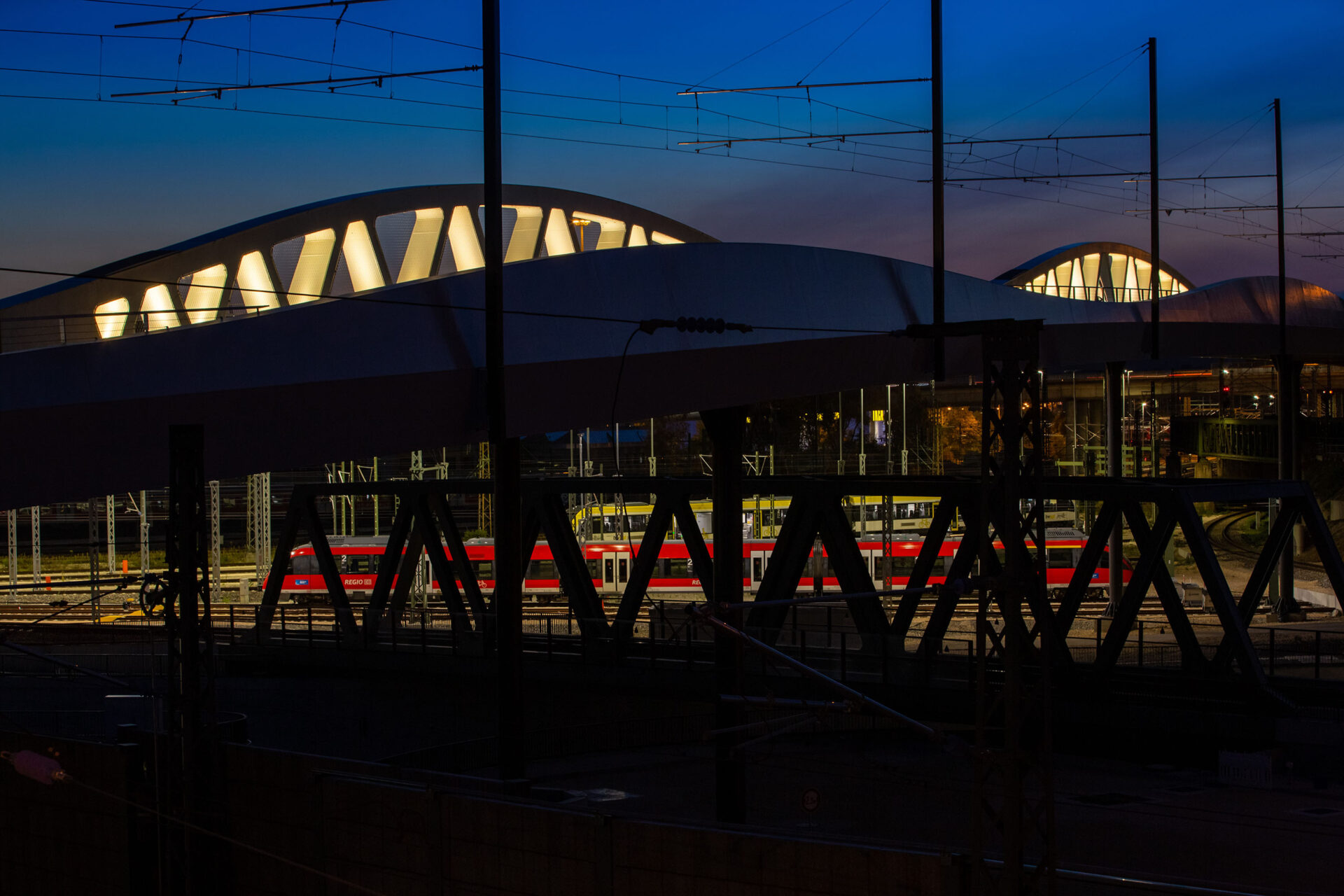
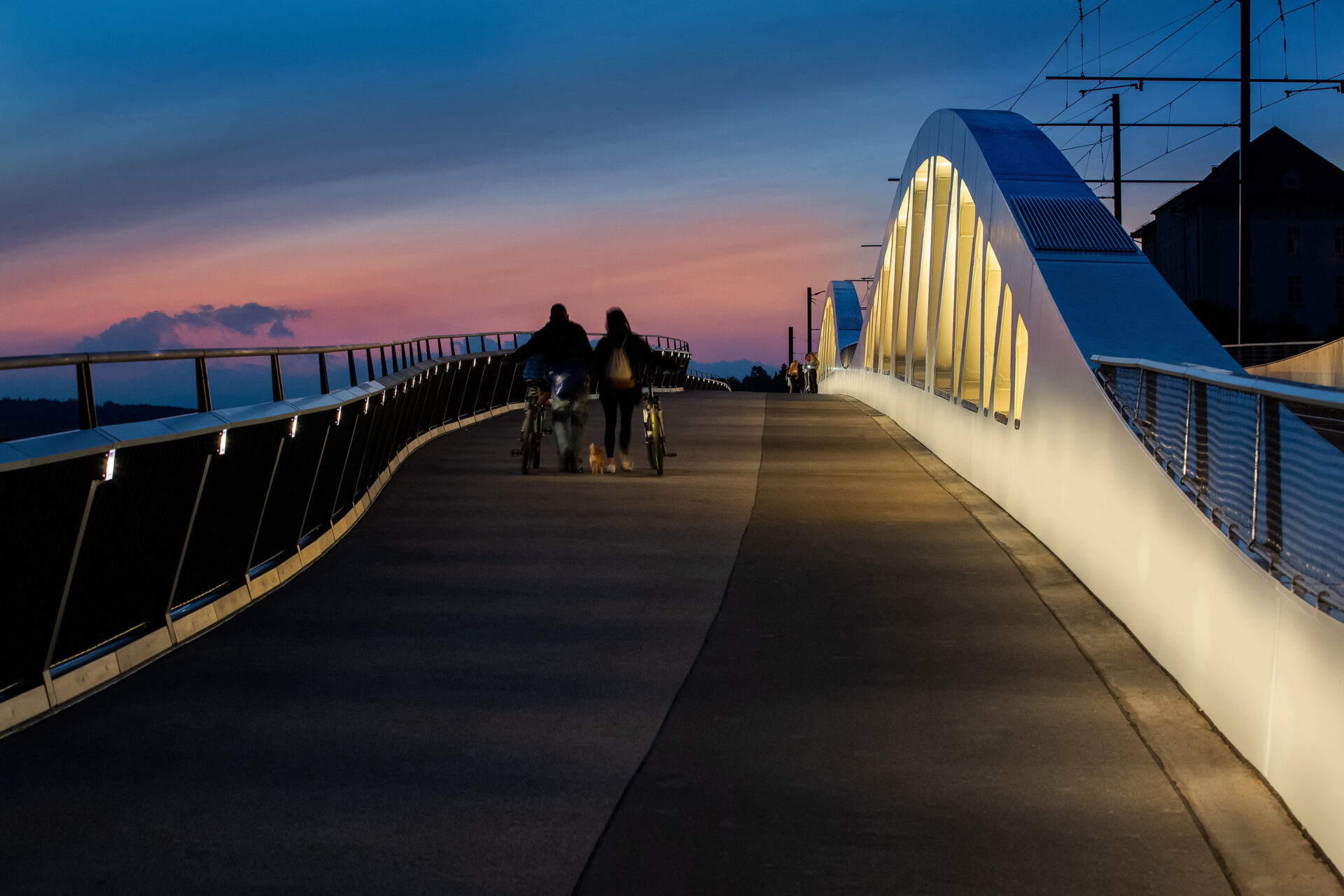
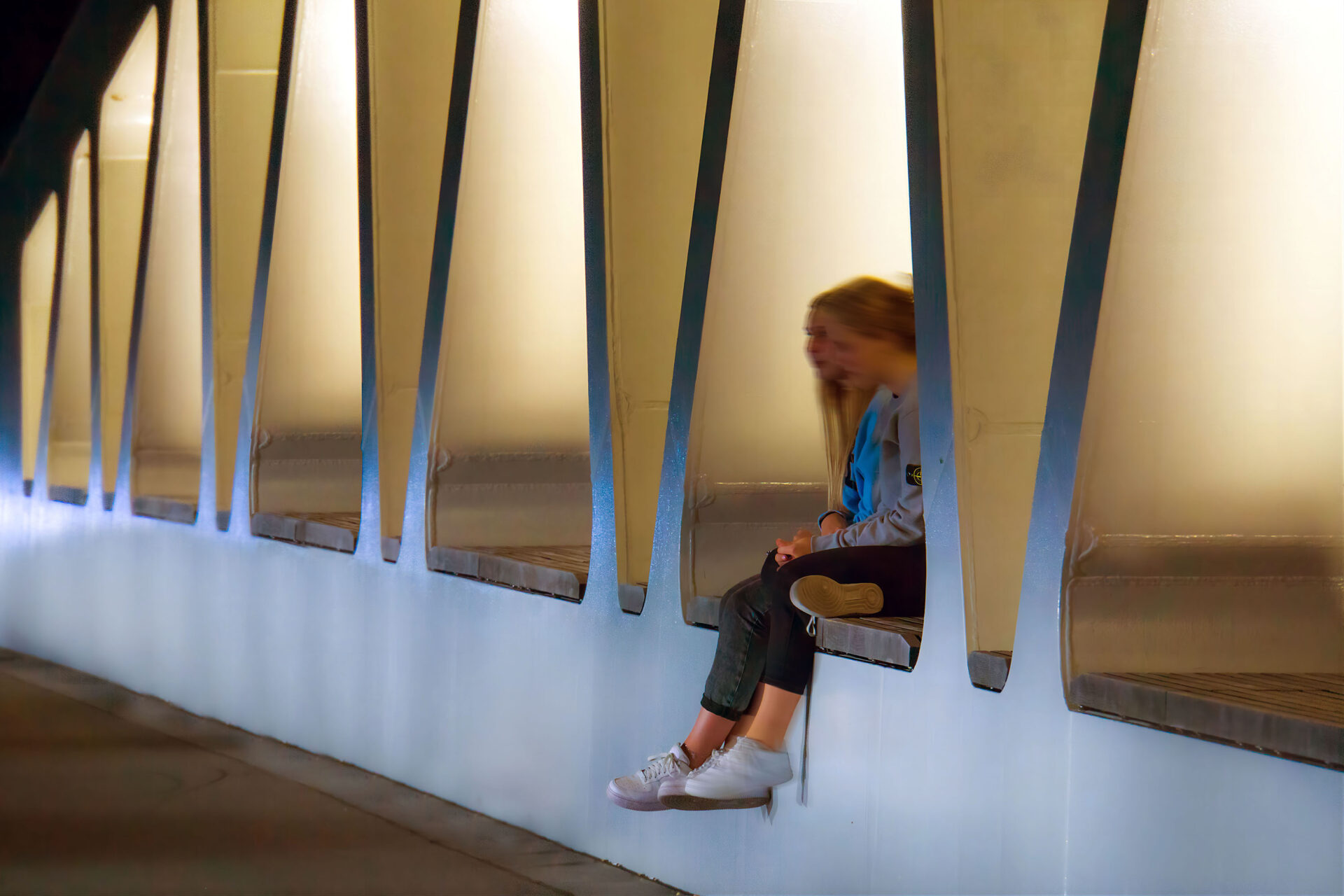
The 270-metre-long Kienlesberg Bridge spans the railway yard west of Ulm's main station, connecting pedestrian, cycle, and tram traffic. The curved structural form with its sculpted infill panels was designed from the outset as a space for perception and relaxation (Knight Architects, Krebs und Kiefer).
Central principle of lighting design the complete integration of the lighting into the structure – without poles or mounted luminaires.
The conscious colour contrast creates legibility of the structure even from a distance, without exaggerating the night-time effect. Indirectly reflected light creates a uniform base brightness with low point-density of light. Areas of anxiety are avoided, visual connections to the surroundings remain unimpeded – a crucial aspect given the elevated position above the railway tracks.
A central criterion of the planning was the avoidance of Nightmares, without increasing the lighting level. What is crucial here is not the number of light points, but their positioning, light distribution, and glare control. The uniform basic brightness is primarily created by indirectly reflected light; harsh light-dark contrasts are avoided. This ensures that room edges, movement areas, and seating areas remain visually perceptible without overemphasising individual zones.
The light points are fully integrated into the supporting structure, yet they can withstand loads and do not impair the user. This reduced, light point strategy minimises vandalism risks and simplifies long-term operation. At the same time, the clear visibility of the space contributes to social control: the location is perceived as manageable, open, and safe – an essential factor in preventing vandalism and ensuring the long-term acceptance of the facility.
The Kienlesberg Bridge is a prime example of how technical requirements, design coherence, and urban identity can be combined – durably and without visual clutter. Furthermore, the lighting concept meets central functional requirements of bridge operation: The visibility of pedestrian and traffic surfaces is reliably maintained even in changing weather conditions such as rain, fog, or dirt. The illumination relates to the structure's geometry and supports the safe orientation of different user groups – pedestrians and cyclists – with the tram running without dedicated lighting on the other side of the bridge superstructure.
The warm white and soft illumination of the bridge's truss structure serves as supplementary vertical lighting for the traffic area. Likewise, through brightness and colour contrasts, it enhances the legibility of the bridge's geometry and, together with seating areas, creates a pleasant place to spend time.
The solution demonstrates that road safety, visual comfort, and the quality of the urban space are not opposites, but rather mutually reinforcing through precise lighting planning.
The lighting consistently follows the pathways and traffic areas, thus supporting orientation and destination perception along the bridge edges and transition zones. The uniform, low-glare light distribution avoids harsh light-dark transitions and reduces adaptation stress – especially in wet or changing weather conditions.
The complete integration of the lights into the load-bearing structure creates robust, low-vandalism systems with high operational reliability. Different usage scenarios can be accommodated through coordinated operating profiles without affecting the bridge's tranquil night-time appearance.“
A clear differentiation is crucial for bridge lighting:
Roadway lighting
The illumination of carriageways, footpaths and cycle paths follows functional criteria, which also apply to roads and paths:
The particular challenge with bridges lies less in fulfilling these criteria and more in not disturbing the architecture. Mast lights or dominant luminaire bodies can overlay the structural form or impair the overall visual impression. Well-planned traffic route lighting therefore consciously recedes and underscores the bridge's architectural appearance, even from a distance.
Stage direction and presentation
The design-oriented lighting, which addresses the structure itself, must be clearly separated from this. The focus here is not on brightness, but on legibility, contour, and scale. The aim is a calm, precise night image that makes the bridge visible as part of the urban structure – without burdening the natural environment.
Bridges are highly complex transition spaces with overlapping uses. Motorised traffic, public transport, cyclists and pedestrians move in a confined space with different speeds, directions of view and safety requirements. Lighting performs an organising function here: it structures the space, makes layers of use legible and reduces potential conflicts.
From a planning perspective, the overall effect of the lighting system is of greater importance than individual parameters. Crucial are calm, uniform light distributions without harsh light-dark transitions, consistent glare limitation, and clear guidance along entrances, transitions, and connection points.
As bridges are often exposed and permanently accessible, light fittings also need to be robust, vandal-resistant and reliable in operation. Safety here is not achieved through increased brightness, but through clarity, orientation and light guidance that makes use understandable.
In addition to design quality and safe usability, operation is a central factor in bridge lighting. Bridges are permanently exposed infrastructure structures: vibrations from traffic, weather influences, pollution, and limited accessibility for maintenance place high demands on lighting systems and their integration.
Sustainable lighting design takes these operational requirements into account from the outset. Fully integrated luminaire solutions not only reduce the visual presence of the technology, but also increase operational safety. Protected installation locations, robust housings and vandal-resistant designs minimise the risk of failure and maintenance effort – a key aspect, especially for bridges over railway lines, bodies of water or heavily trafficked axes.
The lighting systems in use today are almost exclusively based on LED technology, which means they represent the technical standard. Consequently, what is crucial for quality, efficiency, and environmental compatibility is not the light source itself, but its application within the spatial context. The optical design of the luminaires, their precise positioning within the structure, and an operating strategy tailored to the use and surroundings are decisive. Only this interplay enables targeted light control, minimises scattering losses, and reduces energy consumption without compromising visual comfort, safety, or urban spatial impact.
Efficiency is therefore not created by technology alone, but by precise planning – and continues in operation. Sensibly coordinated operating profiles, such as time-of-day dimming or use-based adjustments, allow different utilisation scenarios to be taken into account without compromising the bridge's calm nighttime effect or its distant urban visual impact.
Lighting for bridges thus becomes an integral part of the infrastructure strategy: durable, low-maintenance, and operationally reliable – while also being sensitive to urban space, landscape, and the environment.
In addition to functional illumination of traffic routes, the artistic setting of light for bridges holds independent significance. Due to their exposed location and long-range visibility, bridges often shape the nocturnal cityscape more strongly than adjacent traffic areas. The aim here is not staging in the sense of spectacular effects, but rather a calm, precise legibility of the structure within the urban space. Light here becomes a means of scale, orientation, and identity formation – without dominating natural or landscape spaces.
A successful night-time design is characterised by making the construction understandable, strengthening the architectural character, and simultaneously fulfilling functional requirements. A clear separation between the lighting of traffic routes and architectural lighting is crucial: while the former follows safety-relevant criteria, the latter addresses the building itself as an urban design element.
Example: Arnulfsteg, Munich
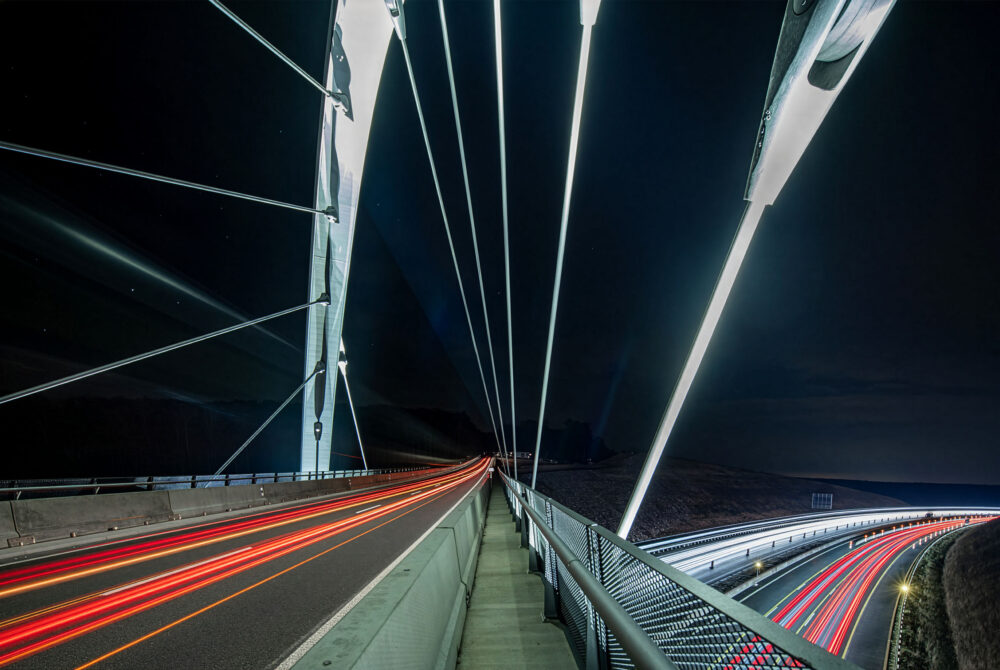
The Arnulfsteg is not just a functional connection for pedestrians and cyclists, but a striking nocturnal landmark in Munich's urban landscape. The lighting concept consistently follows the principle of integration: LED light lines, fully recessed into the structure, subtly accentuate the framework and make the construction clearly legible even at night – without any visible light fixtures or additional poles.
The calm, glare-free lines create a uniform visual presence of the building while simultaneously supporting safe navigation for users. The load-bearing structure itself becomes the focus of perception; light serves the structure, not the creation of effects. The restraint of the lighting prevents an overstatement in the urban space and preserves the sense of scale in relation to adjacent neighbourhoods and landscape areas.
The award of the German Lighting Design Award (2022, Exterior lighting / public areas) confirms that, especially with bridges, restraint, precision, and constructive integration have a more sustainable impact than spectacular staging. The Arnulfsteg exemplifies how night design combines functional safety, urban spatial impact, and design quality – thereby setting a benchmark for contemporary bridge lighting.
Bridges often run through sensitive natural areas – over bodies of water, floodplains, railway lines, or designated FFH (Flora, Fauna, Habitat) areas. Due to their height, exposed location, and widespread visual impact, they have a particularly high potential for light pollution. Light not only spreads along the traffic areas but also extends far into the landscape, affecting aquatic ecosystems, vegetation, and nocturnal fauna.

In the context of bridge lighting, the primary focus is therefore not on energy efficiency, but on the consistent limitation of light emissions. The aim is to ensure that light is only effective where it is functionally necessary – and at the same time to keep it out of the surrounding natural environment.
Central principles are:
In particular, integrated lighting solutions enable quiet, controlled light guidance with minimal far-reaching effects. They avoid unnecessary brightening of the landscape and significantly reduce ecological disturbances. Precise light control is therefore the most effective contribution to environmental and species protection in the context of bridge lighting – and at the same time a prerequisite for the acceptance of such structures in sensitive natural and urban environments.