Melanopic light effect

Non-visual effects between metrology, standards and architectural responsibility

Increasingly, light is reduced to its non-visual effect – to characteristic values, diagrams and spectral curves. However, whether biological effects actually occur is determined not solely by the system, but by the space in which the light acts.
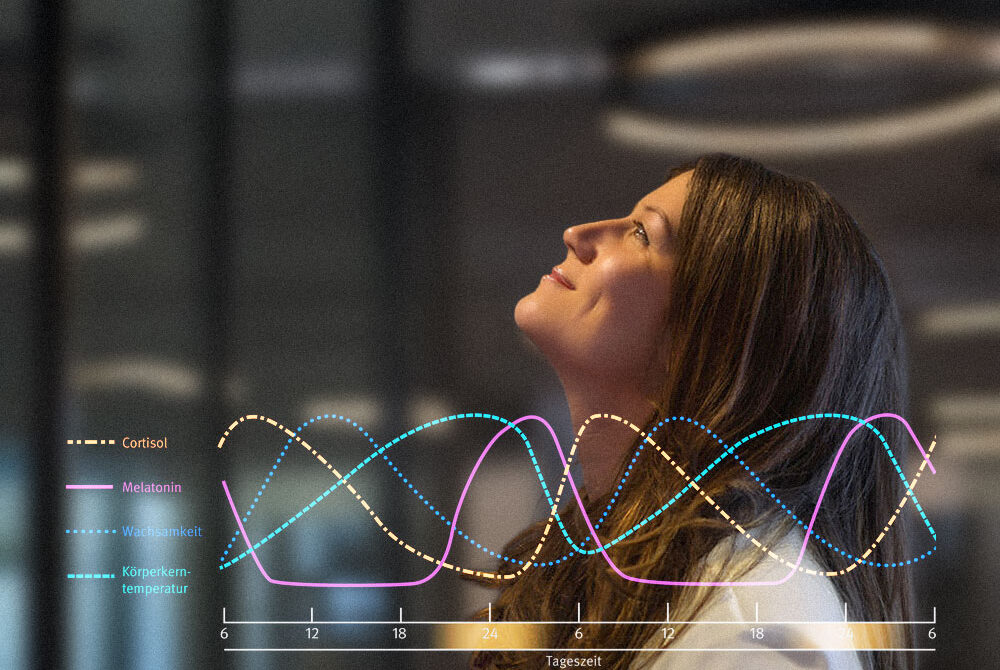
The melanopic light effect describes those non-visual effects that are mediated by melanopsin-containing ganglion cells (ipRGCs) in the eye. These photoreceptors, identified in 2001, are particularly sensitive to short-wavelength light around 480 nm and play a key role in the synchronisation of the circadian system.
This makes light not just a medium for seeing, but an environmental factor with physiological relevance.
At the same time, a planning question arises: How can these findings be integrated meaningfully in architectural terms – without reducing light to a purely technical dimension?
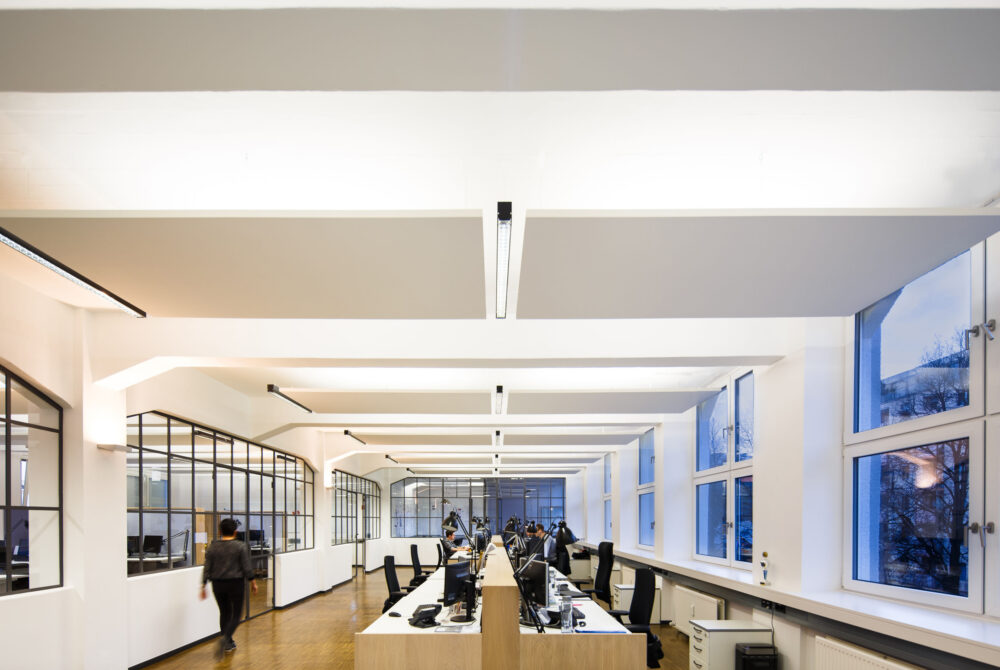
Munich Techpilot by MeierMohr
Melanopic light effect DGUV
Evolutionary biological context

Light as a reference environment

Measured against evolutionary history, humans have only been spending time in artificially lit, rectangular interiors for a very short period. For hundreds of thousands of years, daylight was the dominant light source – dynamic, spectrally complete, and varying with the seasons.
Sun and fire provided a continuous spectrum. Only with electrification did light become technically reproducible – initially via incandescent lamps with a continuous spectrum, later via increasingly spectrally selective systems.
Biophilic design picks up on this insight: architecture attempts to integrate natural environmental conditions – materiality, vegetation, light – more strongly into built spaces.
The most significant environmental factor remains light.
The melanopic lighting effect is therefore not a fashionable extra, but an expression of a more nuanced consideration of humans in space.
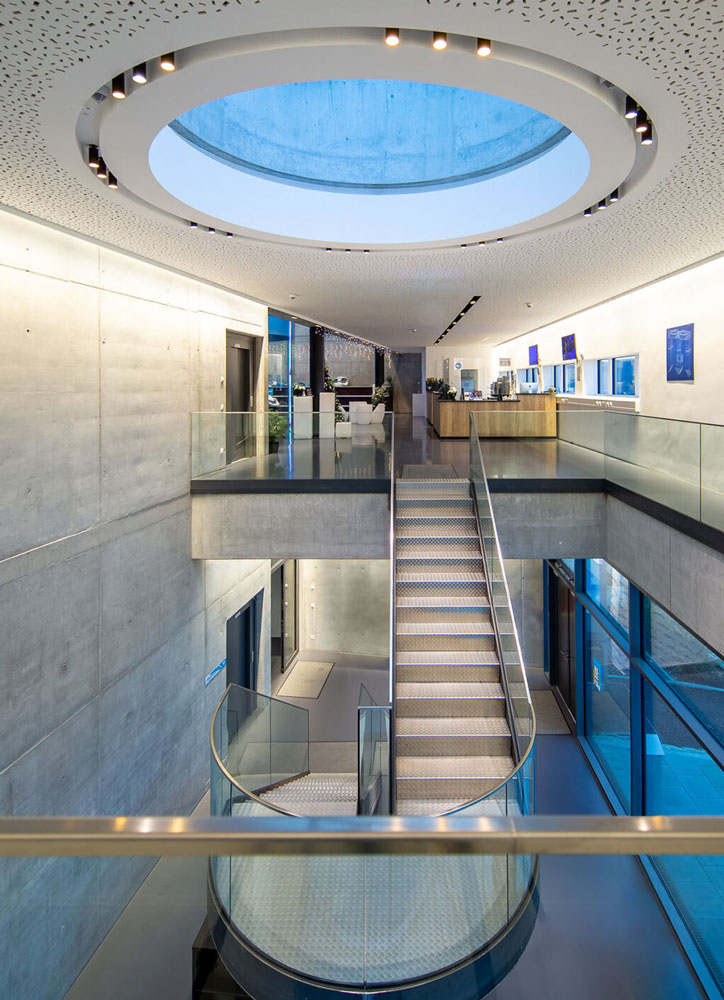
Melanopic light effects

From V(λ) to melanopic evaluation – metrology and standards

The classical light rating is based on the photopic luminance sensitivity curve V(λ), as described in DIN 5031-3. It weights light according to the sensitivity of the human eye in daylight vision.
With the discovery of ipRGCs, it became clear that this visual weighting is insufficient to produce biological effects.
The DIN/TS 5031-100 (the successor to the DIN SPEC 5031-100) defines α-optical parameters – including the melanopic rating. Together with the international standard CIE S 026:2018, it forms the metrological basis for quantifying ipRGC-influenced light responses.
The central key figure is the melanopic Equivalent Daylight Illuminance (melanopic EDI). It describes the illuminance of a D65 reference spectrum that has the same melanopic efficacy as the light being investigated.
What is important here is that both visual illuminance and melanopic EDI are stated in lux – but are based on different spectral weightings.
The melanopic light effect is therefore quantifiable. It becomes measurable. It becomes comparable.
But that doesn't automatically make it architecturally sensible.

DIN/TS 67600 – Recommendation rather than a limit value

The DIN/TS 67600 (2022-08) sets out supplementary design recommendations for non-visual effects of light. It is a technical specification of a recommendatory nature – not a mandatory standard. A frequently cited guideline value is approximately 250 lx melanopic EDI measured vertically at the eye during active phases of the day.

This value is based on consensus-based recommendations (including those by Brown et al.) and is also reflected in the WELL criteria. It is not a threshold value; rather, it serves as a guideline for planning purposes.
The specification supplements the visual requirements set out in DIN EN 12464-1 and ASR A3.4 – but does not replace them.

Here begins the crucial distinction:
Systems thinking measures and controls parameters. Spatial thinking asks about impact in context.

Human Centric Lighting – System Logic and its Limitations

Non-visual lighting effects are often grouped together in practice under the term Human Centric Lighting (HCL). The term primarily originates from the luminaire and system industry. It describes the translation of biological findings into controllable products: tunable white luminaires, pre-programmed circadian rhythms, app-based scenarios.
This system logic has clear strengths:

  • Measurability
  • Scalability
  • Documentability

She simplifies complex contexts into technically manageable parameters.
But it often remains space-agnostic.
Non-visual light effects are not created by spectral shift or intensity curves alone. They arise from the interplay of:

  • Luminance distribution in the field of view
  • Room dimensions
  • Materiality
  • Daylight factor
  • Length of stay
  • Usage patterns

A room with high melanopic values can appear dazzling or atmospherically cool. A room with a moderate melanopic rating can achieve high acceptance if luminance hierarchy, daylight guidance, and visual balance are correct.
This is where the system's limitations become apparent.

Where metric meets atmosphere

The melanopic light effect measures radiation at the eye. However, spatial quality arises from luminance ratios, adaptation, contrast guidance, and transparency.
Research institutions such as Fraunhofer IBP and university studies (including those by TU Berlin and international meta-analyses) show that user acceptance is achieved when both visual and non-visual requirements are addressed together.

Maximising melanopic efficacy is not sensible in every context. Museums, exhibitions, or sensitive materials react sensitively to short-wavelength radiation. Light protection remains the top priority here. Non-visual effects are context-dependent.

Synthesis – Connecting Systems Thinking and Spatial Thinking

Contemporary lighting design integrates:

  • the metrological precision of CIE S 026,
  • the optical principles of the DIN/TS 5031-100,
  • the recommendations of DIN/TS 67600,
  • the visual requirements of DIN EN 12464-1,
  • as well as space-related parameters such as daylight, materiality, and use.

Performance indicators define minimum standards. Spatial conception defines quality.
The melanopic light effect is therefore neither a marketing term nor an isolated target value, but rather a component of a multidimensional planning approach.

Light quality as an integral task

Non-visual light effects are scientifically founded and normatively described today. They allow for a more differentiated assessment of light as an environmental factor. However, their planning quality only emerges when:

  • biological effect,
  • visual perception,
  • Energy efficiency,
  • Material protection
  • and architectural dramaturgy

to be thought about together.

Light is not a pure performance value. It is a space-defining medium.
The melanopic light effect makes this connection more precise – it does not replace it.

Standards and Sources

The assessment of melanopic light effects is based on a now clearly defined metrological and normative foundation. The following documents form the currently recognised reference framework for planning, assessing, and classifying non-visual effects in indoor environments:
CIE S 026/E:2018
System for the Metrology of Optical Radiation for ipRGC-Influenced Responses to Light

DIN/TS 5031-100:2021-09
Non-visual effects of light on humans – Quantities and spectra of action

DIN 5031-3:2019-07
Photopic luminous sensitivity V(λ)

DIN/TS 67600:2022-08
Supplementary criteria for lighting design with regard to non-visual effects

DIN EN 12464-1:2021-11 Lighting of indoor workplaces

ASR A3.4 (current version) Lighting

VDI 6011 Sheet 2
Use of natural light and artificial lighting

DGUV Information 215-220 (2018) Non-visual effects of light

Brown et al., Current Biology (2019) Recommendations for indoor light exposure

WELL Building Standard – Lighting Concept