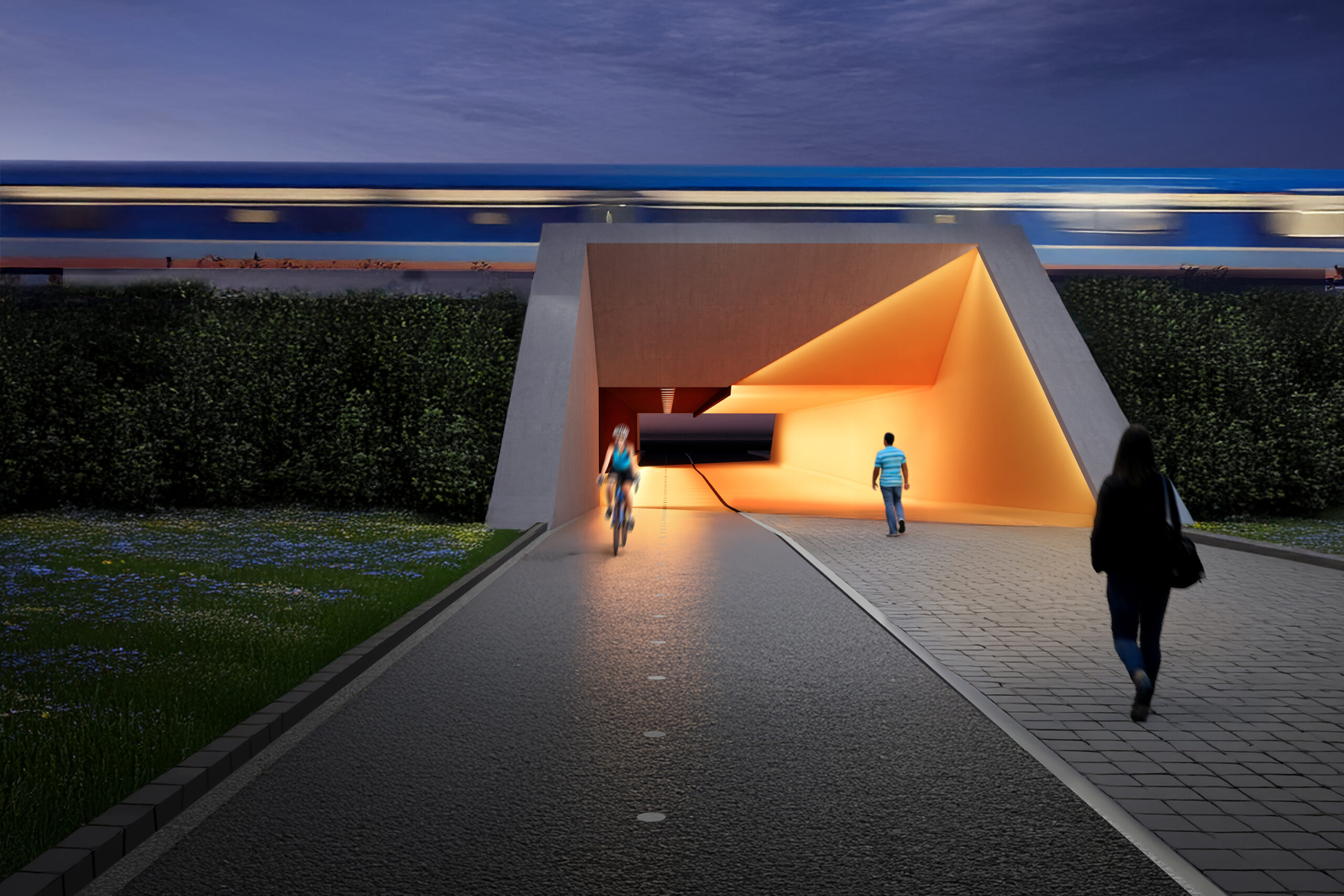
Underpasses are among the most sensitive places in public spaces. Often still perceived as non-places or spaces of fear, they are in reality highly relevant components of urban infrastructure. They connect neighbourhoods, function as bridges or create access, and shape everyday movement flows. Where lighting is absent or inadequate, insecurity and isolation arise – but with thoughtful design, underpasses can become places of urban and atmospheric quality.

Underpasses mark thresholds between urban spaces. Visitors leave a familiar place, traverse a zone of transformation, and enter a new urban environment. This process of transition is not only functional but also atmospherically significant. Light, spatial design, and materials shape the perception of this transition, conveying not only orientation but also identity.
The effectiveness of an underpass depends entirely on the lighting concept. Functional and artistic approaches only achieve their full impact under good lighting conditions. Central to this is visual adaptation at the entrance and exit: during the day, the transition from sunlight to darkness and then back out into bright light often leads to a „cave effect“; at night, this relationship is reversed.
A lighting concept that takes account of changing daylight balances out these extremes, creates safety and simultaneously opens up atmospheric staging possibilities. This can already be achieved in static systems with the correct handling of luminance and can be optimised through daylight-dependent and needs-based dynamic controls.
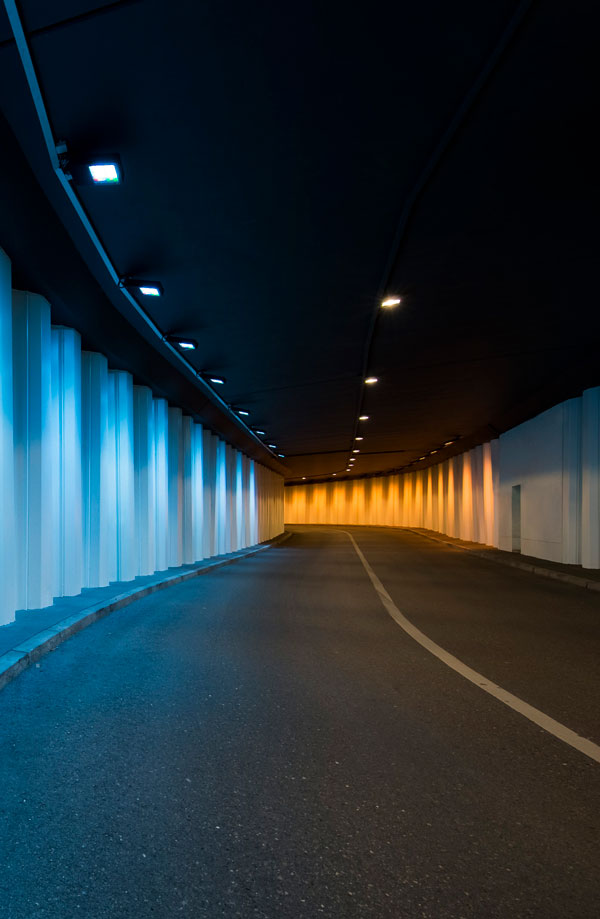
Underpasses must offer safety and orientation for all user groups. Accessibility is therefore a central planning principle. High-contrast lighting, illuminated guidance strips, and orientation aids for visually impaired people enable inclusive use – from children to seniors. This heterogeneity places special demands on lighting design:
Pedestrians need orientation, facial recognition and social security.
The feeling of safety is shaped not only by light but also by sound. Sound-absorbing materials, combined with harmonious lighting design, transform underpasses from purely functional passages into pleasant spaces with quality for the place and the journey.
Underpasses are part of a larger overall urban system. Their lighting must integrate with urban lighting and orientation concepts.
Escape routes, emergency lighting, and technical systems must function at all times – even in the event of a power failure, contamination, or age. Lighting design must integrate these aspects early on, rather than technically „bolting them on“ later.
Consistent orientation, fluid transitions, and clear integration into pathways and plaza systems make them integral components of urban identity.
Continuous operation, increased pollution, and limited maintenance windows necessitate robust, low-maintenance systems with clear light distributions. Material quality, accessibility, and long-term spare parts availability are just as crucial as the lighting effect itself.
Underpasses are sensitive spaces – which is why vandalism protection plays a significant role. However, it doesn't just start with impact resistance and washability. The design itself is crucial: brightness and clarity create social control, make movements visible, and reduce the feeling of isolation. A well-designed underpass is sought out as a connecting route and not avoided.
Numerous studies show that lighting cannot be considered in isolation as a safety-relevant factor, but rather acts in conjunction with the spatial design, usage density, and social perception. Visibility enables social control – and this acts as a deterrent to delinquent behaviour.
Well-planned lighting is a tried and tested method for increasing subjective and objective safety in public spaces. Brightness and visibility enhance social presence and act as a deterrent against vandalism and crime – and high-quality design counteracts the „broken window“ principle. Visibility through light enables social control and demonstrably leads to fewer criminal offences.
Key research findings:
Light works in two ways: it not only improves Objective safety, but also the subjective feeling of safety. For planners, this means that lighting in underpasses, on station forecourts, or in conflict zones must always be considered as part of a integrated security strategy to be understood – in conjunction with interior design, acoustics, and social control.
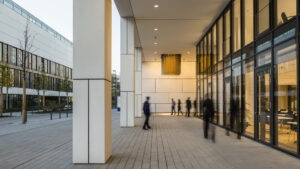
Exemplary projects from [organisation name] show how underpasses can be enhanced through lighting. DAY & LIGHT. They illustrate how technical precision, psychological impact, and artistic design interlock and transform non-places into urban experience spaces.
Underpasses are ideal for artistic interventions. As threshold spaces with an extraordinary character, they offer perfect stages for light art, atmospheric installations, and creative experiments. Functional safety and design quality can find a new balance here.
Light Art Project „Studentenweg"“, University Hospital Cologne (CECAD)
The „Studentenweg“ light art project transforms the busy passageway into a safe, atmospheric, and identity-affirming route. Precisely at the point receiving the least daylight in the entire building complex, a special experience is created through the artworks of metal sculptor Yoshiyuki Miura. They are illuminated by sun-like beams of light that strike the floor beneath. The intense effect of this combination of object, light, and space transforms the functional passageway into a place with a unique spatial experience that not only guides users safely but also appeals to them emotionally. The combination of artistic light installation and functional lighting design creates a space that harmonises quality of stay and orientation.
A design concept that infuses the space with emotion whilst ensuring it remains practical and functional – an example of the balance between functional safety and artistic intervention.

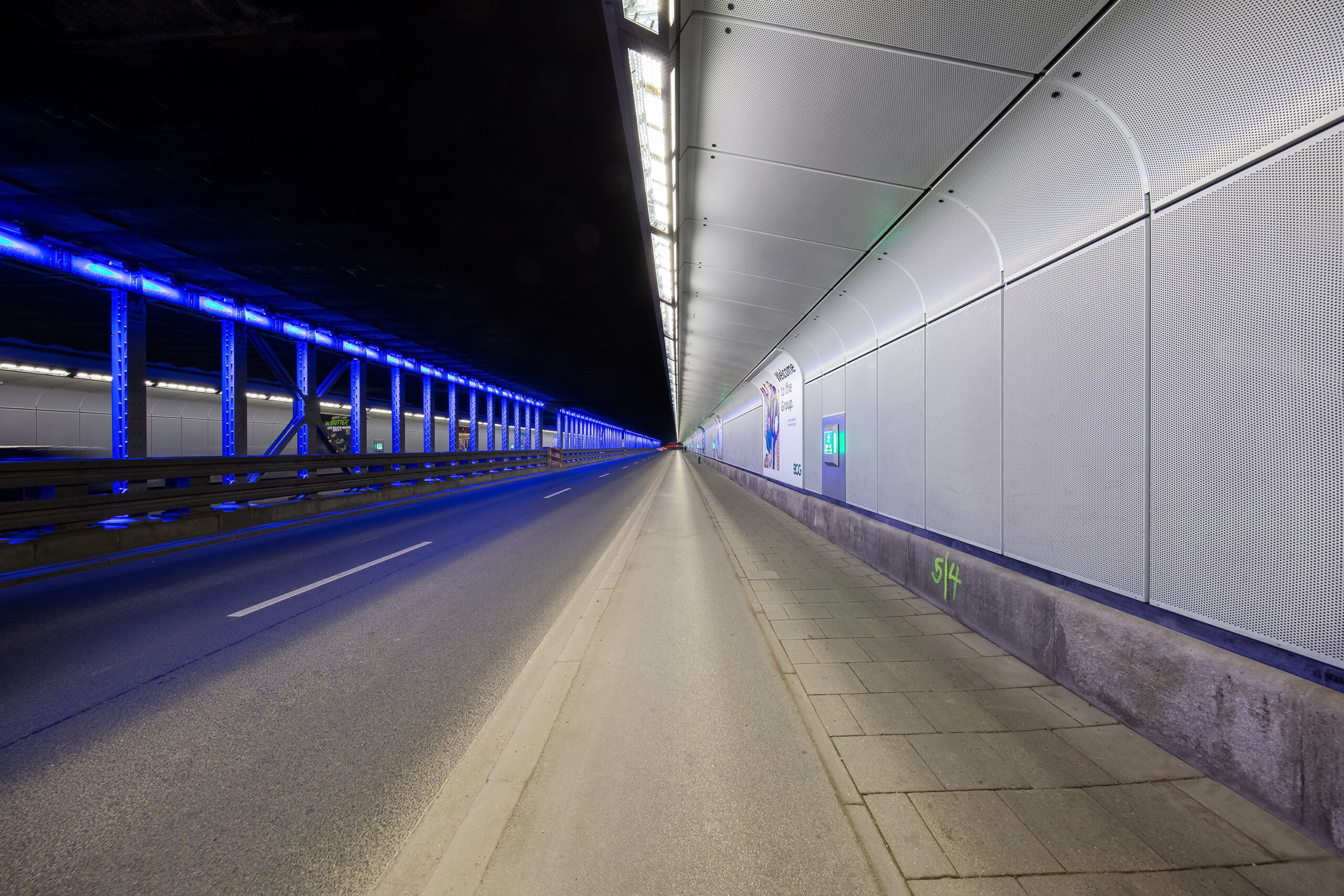
In the Paul-Heyse Underpass, the lighting concept was specifically designed to improve spatial perception and orientation. The previously point-like, heterogeneous lighting was replaced by uniform, wall-adjacent light guidance – fully integrated and without mounted luminaires.
The new lighting design reduces the feeling of visual confinement, enhances the clarity of the space and boosts the sense of security, particularly at times when social supervision is limited. The soft, low-glare light distribution prevents harsh light-dark contrasts; the edges of the room and areas where people move remain clearly visible at all times.
The project demonstrates exemplarily how underpasses can be developed from functional passageways into clearly structured, accepted urban spaces through the use of light – with a focus on perception, orientation, and operational safety.
The renovation of the Paul-Heyse-Underpass, Nominated for the 2023 German Lighting Design Award, it serves as a prime example of how technology, psychology and design can intertwine. DAY & LIGHT carried out the project in collaboration with Meyer Lighting and other partners, focusing on three key measures:
The result: an urban development example of how underpasses can shed their former function as non-places and become experienceable, identity-creating urban spaces.
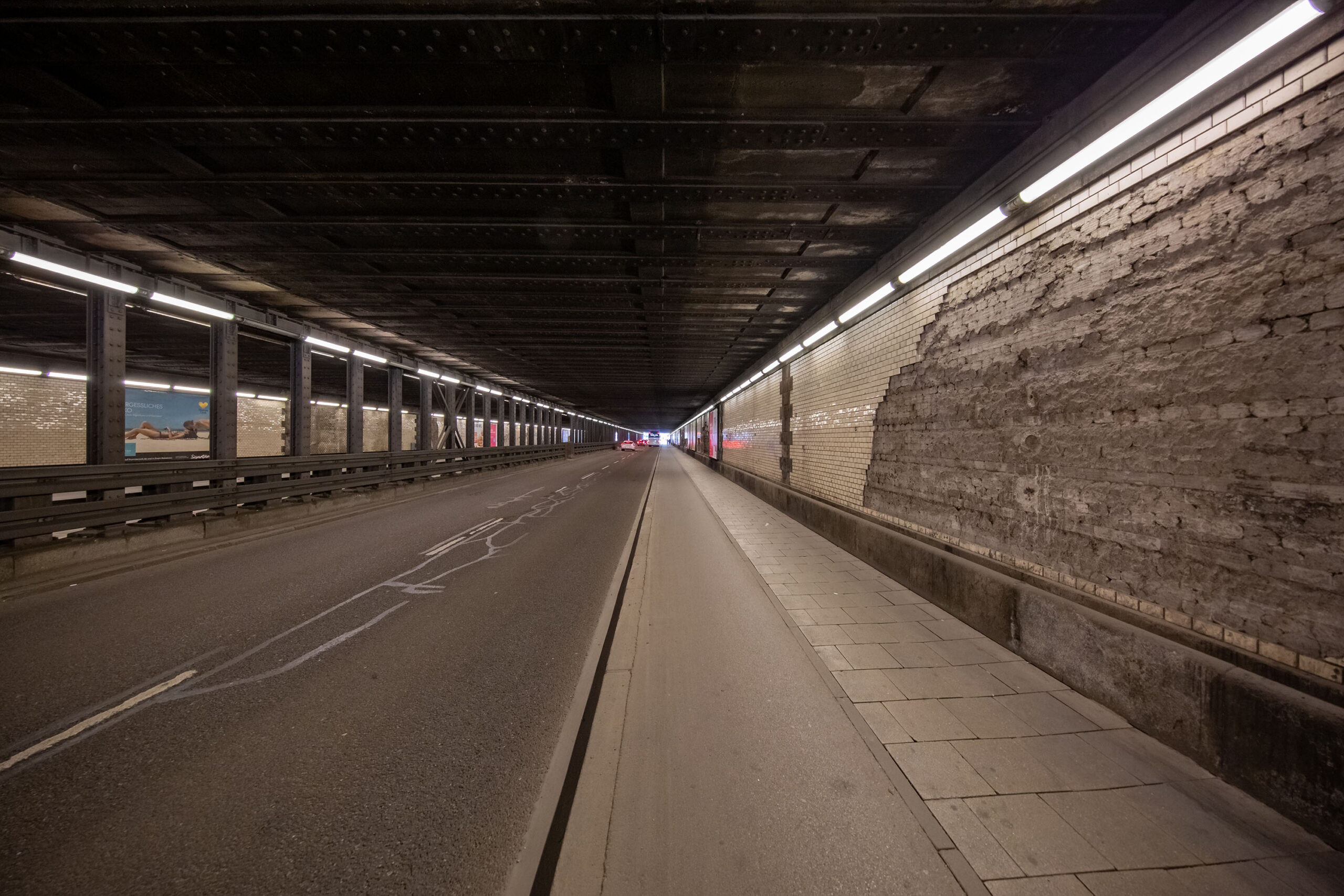
Underpasses are urban threshold spaces, the quality of which is significantly determined by light. Accessibility, acoustics, information systems, sustainability and artistic design are the keys to transforming spaces of fear into identity-creating places.
DAY & LIGHT sees these spaces as a design and societal challenge: functional passageways are transformed into urban experience spaces that reconcile safety, orientation, and identity.