Lighting Masterplan

Lighting design

Urban lighting has long been more than just functional infrastructure. It structures spaces, guides movement, influences safety, orientation and quality of stay – and often shapes a city's nocturnal image more strongly than its daytime architecture. Nevertheless, in municipal practice, lighting is still often treated as an isolated technical solution: localised, reactive, and detached from overarching urban planning, ecological, and operational contexts.

Cities face fundamental challenges in this regard. Energy efficiency, climate protection, species conservation, demographic change, conflicts of use in public spaces, and increasing demands for safety and quality of life can no longer be addressed in isolation. Light thus becomes a strategic medium – not only because it is visible, but because it has an effect: on people, on spaces, and on ecological systems.
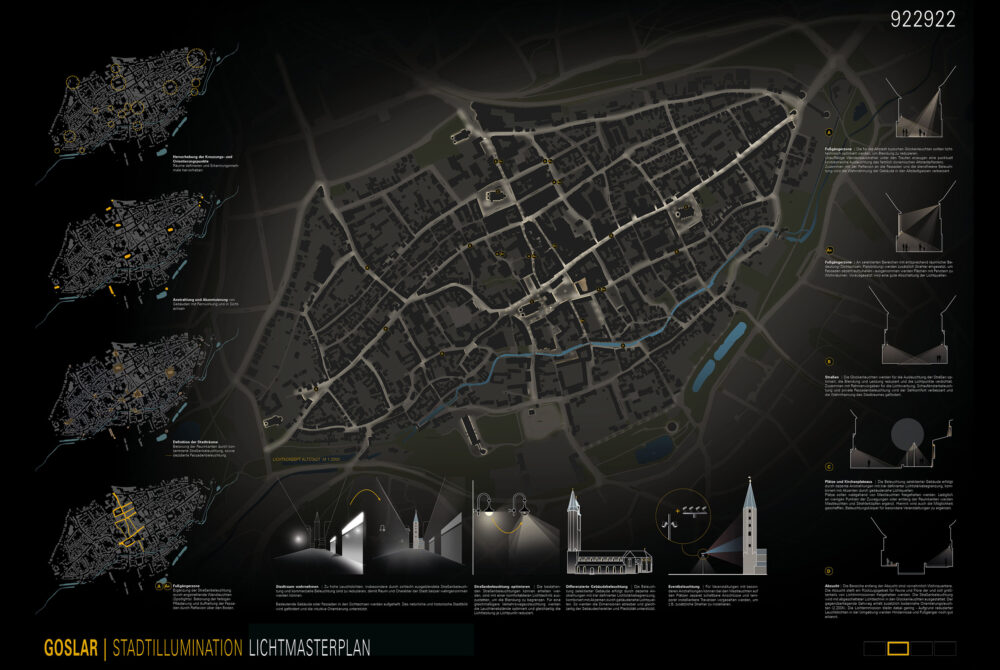
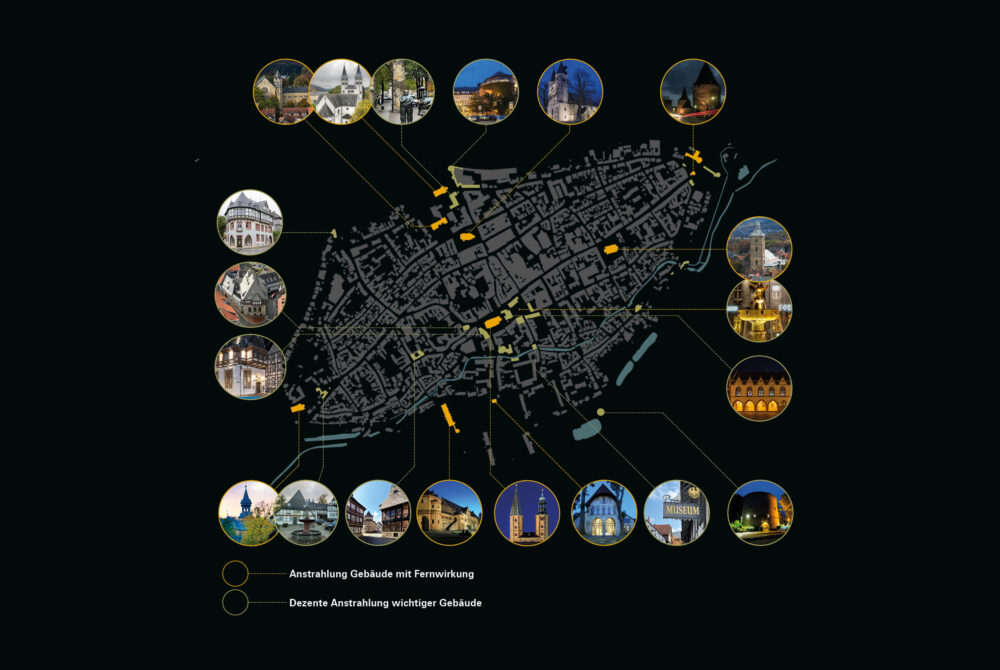
Goslar Masterplan Poster

A lighting masterplan picks up exactly at this intersection. It understands light not as an end in itself, but as an integral component of urban development. The aim is not a standardised night-time image or blanket uniformity, but a consciously controlled interplay of function, design, operation and environmental responsibility. The lighting masterplan creates a framework within which decisions can be made in a comprehensible, consistent and long-term sustainable manner.

A lighting master plan does not replace design or project-specific planning – on the contrary, it creates the conditions for projects to be developed in a high-quality, context-specific, and future-proof manner. Instead of focusing on individual luminaires or illuminance levels, it centres on visual comfort, spatial legibility, and the nocturnal identity of the city.

A central guiding principle here is the departure from the long-dominant equation of brightness and quality. More light does not mean better vision. On the contrary: over-illumination, glare, and a lack of coordination between light sources impair perception, increase energy consumption, and burden the environment and urban spaces. Good lighting design works with precision, restraint, and a clear approach – it uses light purposefully and allows darkness where it is functionally, ecologically, and aesthetically sensible.
views

1. Why a lighting master plan is a management tool today

Cities face the challenge of meeting a multitude of different demands in public spaces simultaneously: safety, quality of stay, energy efficiency, climate protection, species protection, economical operation and urban identity all affect the same space. Lighting is not a subsequent fitting factor, but an effective means of control.

In practice, however, light is often treated in a fragmented way: technically standardised, decided on a project-by-project basis, and without overarching coordination. The result is additive night-time images, high operating costs, and a lack of spatial coherence.
A lighting masterplan addresses this by detaching lighting from the level of individual measures and establishing it as a strategic instrument for urban development.

Are you currently working on a lighting master plan and would like some support?

Then please feel free to ask us.

 
To the technical article


2. From Individual Project to Strategic Order

The added value of a lighting master plan lies not in the specification of individual luminaires or illuminance levels, but in the development of an overarching framework. It asks fundamental questions that are often asked too late in the daily project routine:

  • Where is light necessary – and where is darkness a quality?

  • Light plays a role in safety, orientation, and identity.

  • How can different uses and times be combined into a consistent overall system?

The lighting master plan thus creates a strategic order that makes priorities visible, structures conflicting objectives, and places individual measures within a comprehensible context.


To the technical article


3. Light as a component of integrated urban development

A contemporary lighting masterplan does not consider lighting in isolation, but as part of integrated urban development. It links lighting with urban structures, mobility, open spaces, heritage protection, ecology, and operation.

This is how light becomes a connecting element between disciplines. The lighting master plan serves as a common reference for administration, planning, policy, and the public – and enables decisions to be communicated transparently and implemented consistently in the long term.

 
To the technical article


4. Methodology of a Lighting Master Plan – From Urban Space to Lighting Strategy

The quality of a lighting masterplan arises from its methodology. The starting point is not the luminaire, but the urban space: its structures, uses, atmospheres and perceptual spaces – by day and by night.

Through analysis, typologisation and guiding principles, light is translated into a strategic logic. This creates a light strategy that provides orientation without replacing design and enables decisions without pre-empting them.


To the technical article


5. Seating comfort as a guiding principle

More light does not mean better vision. Over-illumination, glare and disordered light distributions impair perception, increase energy consumption and reduce the quality of stay.

The lighting master plan focuses on visual comfort: balanced luminance ratios, clear spatial readability, and targeted light control. This makes light quality the central benchmark – not the lux value.


To the technical article


6. From Plan to Instrument – Commitment, Implementation and Governance

A lighting masterplan is only effective if it is applicable in everyday life. It does not replace standards, but complements them with an urban spatial perspective. Its enforceability arises from clear principles, not from rigid specifications.

By integrating into existing planning, decision-making, and operational processes, the lighting master plan becomes a practical decision-making tool – for administration, politics, and planning.


To the technical article


7. Environment, species protection and responsibility – Darkness as a resource

Light is an environmental factor. Light pollution, sky glow, and excessive luminance levels impact ecosystems and fragment habitats. The Light Masterplan therefore views environmental and species protection not as an add-on, but as an integral part of lighting design.

Through spatial differentiation, precise light guidance, and conscious limitation, darkness is recognised as an ecological and design quality – and light is used responsibly.

To the technical article

DAY & LIGHT does not view lighting masterplans as static sets of rules, but as dynamic planning tools. They combine analysis, vision and implementation logic, providing guidance for policymakers, administrators, planners and operators. The key is not to exercise complete control over the night-time environment, but to be able to structure complex requirements and facilitate sound decision-making.

The Ingolstadt Lighting Masterplan demonstrates how holistic municipal lighting planning works: strategically, integratively, and responsibly. It shows how cities can make their nocturnal appearance not only more efficient but, above all, better – for people, for the urban space, and for the environment. We are eager to share and deepen our experiences.

views

Funding rates (as of 2026):

  • Standard municipality subsidy rate 30–40 %

  • Structurally Weak Region (GRW) Funding rate up to 55 %

  • Specific target groups (e.g. local authorities with nurseries/schools, lignite mining areas) Funding rate of up to 65 %

Link Council Policy

Long-term planning ensures sustainability.

Eligibility is based on a technical and legal foundation that meets all relevant requirements:

  • DIN EN 13201 – Street lighting and outdoor spaces
  • DIN SPEC 67600 – The biological effects of light
  • VDE 0108 - Emergency lighting

Which demonstrably saves at least 50 % tonnes of CO₂, incorporates adaptive control functions, forms part of a lighting concept or master plan, and prevents light pollution, glare and stray light
and is fully documented and calculated according to standards.

This is how to create robust, fundable applications with a high chance of success.
DAY & LIGHT provides systematic support to local authorities:

  • To carry out feasibility studies and CO₂ verifications
  • Planning of adaptive lighting control with evaluation
  • Creation of political and technical documentation
  • Co-ordination with building authorities, energy suppliers, urban development
  • Accompanying tenders and securing proof of use

Funding programmes

For cities and municipalities in Germany, there is extensive financial support for the implementation of sustainable and energy-efficient lighting systems.
In addition to improving energy efficiency, they also aim to reduce light pollution and preserve natural nightscapes.

  1. Funding CompassLighting
  2. Community DirectiveKLR
  3. National Climate Protection Initiative NKI